
Here’s the moment that happens to almost everyone learning how to learn Quranic Arabic: you’ve done an app, maybe a beginner course, and you can hold a basic conversation. Then you sit with a surah you’ve recited since childhood, actually trying to read it, and something’s off. The words look familiar. The sentence doesn’t.
That gap isn’t a sign you did something wrong. It’s a sign you learned a different Arabic than the one this job requires. Modern Standard Arabic and the dialects are useful — for news, for travel — but they weren’t built for a text revealed fourteen centuries ago, a classical register that has remained highly stable since.
What follows is a roadmap for closing that specific gap.
How to Learn Quranic Arabic Grammar Without Drowning in It
People searching for how to learn Quranic Arabic grammar usually land on a full classical syntax textbook within a week. Many stall around chapter three. Wrong entry point.
Three things do many of the work. Verb form recognition — Form I versus Form II can shift meaning in ways that are easy to walk past. Case endings, i’rab, sometimes silent in ordinary recitation but the thing telling you who’s doing what once a sentence stretches past subject-verb-object. And particles — the small connecting words — carry more interpretive weight here than in casual speech, where tone usually covers for them.
Ibn al-Jazari, a major scholar of Quranic recitation, treated correct articulation and understanding as essential to recitation.
The common mistake is finishing grammar before reading starts. Works better reversed — study ten verb forms, then go hunting for them in real ayat immediately. That sticks. Isolated drilling on a whiteboard doesn’t.
If understanding the Quran as you recite it is the actual goal — not conversation, not travel Arabic — Alif Arabic’s Quranic Arabic course is built around that transition.
Building Quranic Arabic Vocabulary That Actually Sticks
A relatively small set of root words accounts for a large share of the Quran’s vocabulary. The exact percentage shifts depending on who’s counting, so take any specific figure with caution — but the principle holds. Master the frequent roots, unlock disproportionate comprehension.
The trap is treating that frequency list like flashcards to drill in isolation, the way you’d cram for a language exam. Quranic vocabulary resists rote memorization more than many material does, because so many words shift meaning depending on grammatical form and the sentence around them. Knowing the root ر-ح-م relates to mercy is a fact. It isn’t the same as sitting with رحمة rahma, رحيم rahim, and رحمن rahman inside their real verses.
What holds up better is meeting vocabulary inside real ayat from day one — reading as the primary vehicle, not flashcards as a warm-up before reading starts. A word met inside its verse arrives already carrying grammar and context together, which is exactly what isolated memorization strips apart.
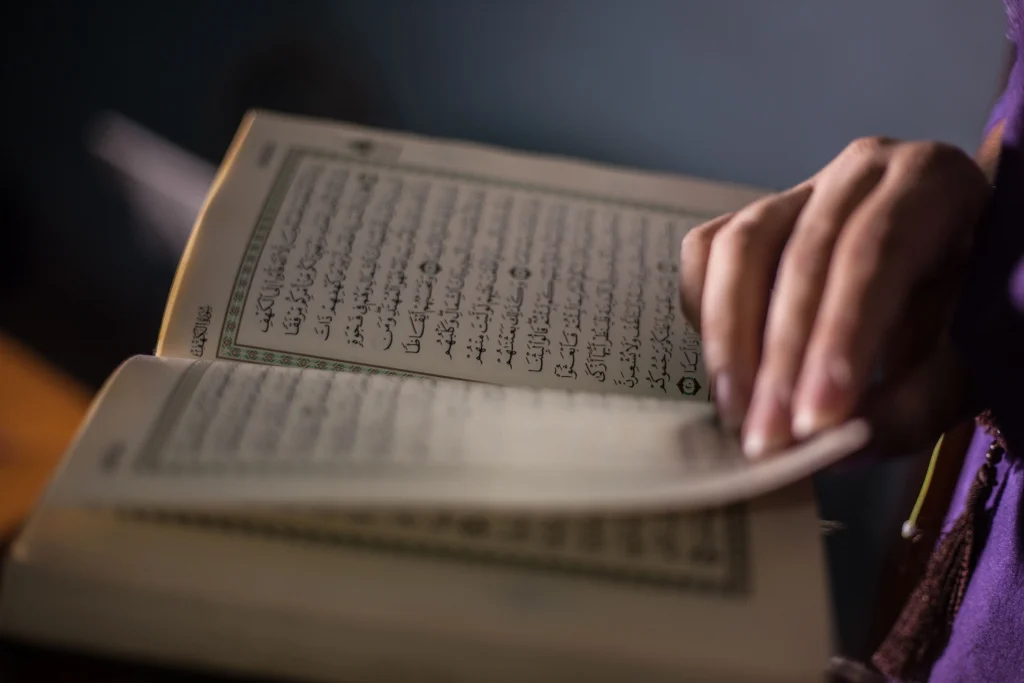
Learn Quranic Arabic Online or Teach Yourself?
Self-study has real things going for it: no fixed schedule, no cost barrier with free resources, freedom to move at your own pace. It also has a failure mode worth naming — without outside structure, it’s easy to spend six months circling the same plateau, rereading familiar surahs, never quite pushed toward the grammar that would move things forward.
Structured programs to how to learn Quranic Arabic online aren’t solving that by being inherently better teachers. They solve it by supplying sequencing and feedback a self-taught learner otherwise has to invent, usually badly, usually too late. A decent course sequences grammar and vocabulary on purpose. A live instructor can catch a misunderstanding before it calcifies into a year-long habit.
Neither path is automatically the wrong call. It depends on how disciplined your habits already are, and how much accountability you need once the material stops being easy.
Learners who want structure without losing the point — understanding, not just reciting well — often find Alif Arabic’s Quran for Adults course pairs Tajweed with comprehension from the start.
How Long Does It Actually Take To Learn Quranic Arabic
No single timeline here, and if anyone tells you ninety days, they’re selling you something, not telling you the truth. What I can say with more confidence: someone who already reads the script fluently, and actually studies consistently, can usually get to real comprehension of common vocabulary and core grammar somewhere in a year or two of steady work. Not fluency in the broader language — that’s a different, bigger target. Just functional comprehension of the text itself, which is smaller and, honestly, a lot more achievable.
The variable that moves this most isn’t raw hours. It’s whether those hours go toward material built for Quranic Arabic specifically, or general Arabic courses that mention the Quran occasionally. Two learners logging identical hours land in very different places depending on which bucket their material falls into.
If the missing piece is reading the script itself with real fluency — not just recognizing letters, but reading at speed — the Arabic Reading Course at Alif Arabic closes that gap before the grammar work starts.
What Understanding the Quran Actually Changes
Many guides end on mechanics. One last push, check the box, done. That misses something. Al-Ghazali wrote about intention as the thing shaping what knowledge becomes for the person pursuing it — the same information, chased for different reasons, turns into something different. Studying grammar to pass a test and studying it so the words in your salah actually land aren’t the same project, even when the flashcards look identical.
This work is genuinely slow. A learner who loses sight of why they started tends to quit around month four, right when material stops being new and starts being difficult in the boring way. The ones who keep going aren’t necessarily more disciplined — they can still feel, underneath the case endings, the original reason they wanted to know what a verse meant instead of just recognizing how it sounds.
If you’re ready to put a real plan behind this instead of starting again, Alif Arabic’s Quranic Arabic course walks through grammar and vocabulary in roughly this sequence.
Frequently Asked Questions
Is Modern Standard Arabic a waste of time if my only goal is the Quran?
Not a waste, but not sufficient alone. MSA gives you the alphabet, root system, and general sentence sense, all of which carry forward. The gap shows up when people stop there and assume Quranic comprehension follows automatically. It doesn’t.
How much grammar do I need before reading with understanding?
Less than you’d think. Enough for basic sentence structure and common verb forms — not a finished classical grammar textbook. Many learners do better starting on short, familiar surahs early and building grammar alongside that reading.
Is it normal to plateau after the basics?
Yes, completely normal — I’d actually say it’s one of the most common places people give up, mistaking it for evidence they’re not cut out for this, when really it just means the easy, high-frequency stuff has been absorbed already. What comes next needs more deliberate work, not more passive exposure.
Can I really learn Quranic Arabic online, or does it need to be in person?
I’d say online study works — actually, let me be more specific: it works for grammar and vocabulary instruction particularly well. Whether it works for you depends less on “online vs. in person” and more on whether the specific program has real structure behind it. Real-time correction is possible either way, if the format includes live sessions.
What’s the single biggest mistake beginners make?
Probably assuming Quranic Arabic is basically general Arabic with religious vocabulary added — which, to be fair, isn’t entirely wrong, there is real overlap. But treating it as the same project is where people go wrong, and materials that don’t draw that line clearly tend to produce learners who’ve seen a lot and understood less of it.


