
You finish your first Arabic class feeling great. You can say hello; you know a few letters. Then you open the Quran, and it feels like a different language. Or you do the opposite: spend months on Quran, travel somewhere, and nobody understands a word you say.
Sound familiar? It isn’t your fault. Nobody told you there are different types of Arabic, and that each one does a different job.
So let’s sort them out. By the end, you’ll know which one matches why you’re learning Arabic for Quran, work, or family.
Types of Arabic: The Three You’ll Run Into
There are three main types. Classical Arabic is the language of the Quran and much early Islamic scholarship. Modern Standard Arabic (MSA) is the formal kind you see in newspapers and hear in speeches. And then there are the dialects, which are what people actually talk in at home. They change from country to country, and sometimes from one city to the next.
Here’s something that confuses learners. Arabic speakers often lump the first two together and call them fusha (الفصحى). They don’t stop and say “this bit is classical, that bit is modern.” You do have to, because you’re building the skill from scratch.
The good news? It’s all one script, one root system, and loads of shared vocabulary. You’re not learning three languages. Still, the gap between spoken and written Arabic is big, so it’s worth reading about the difference between the Arabic language and the colloquial language before you pick a class.
Letters also change shape depending on where they sit in a word, whatever type you study, so get comfortable with the different forms of Arabic letters early. If you’re still shopping around, where to start with Arabic courses online might save you a few wasted weeks.
Not sure which of these types of Arabic suits you? The Arabic for Adults course at Alif Arabic starts from the ground up with Al-Azhar graduates, which makes it a gentle first step.
Classical Arabic: The Arabic of the Quran
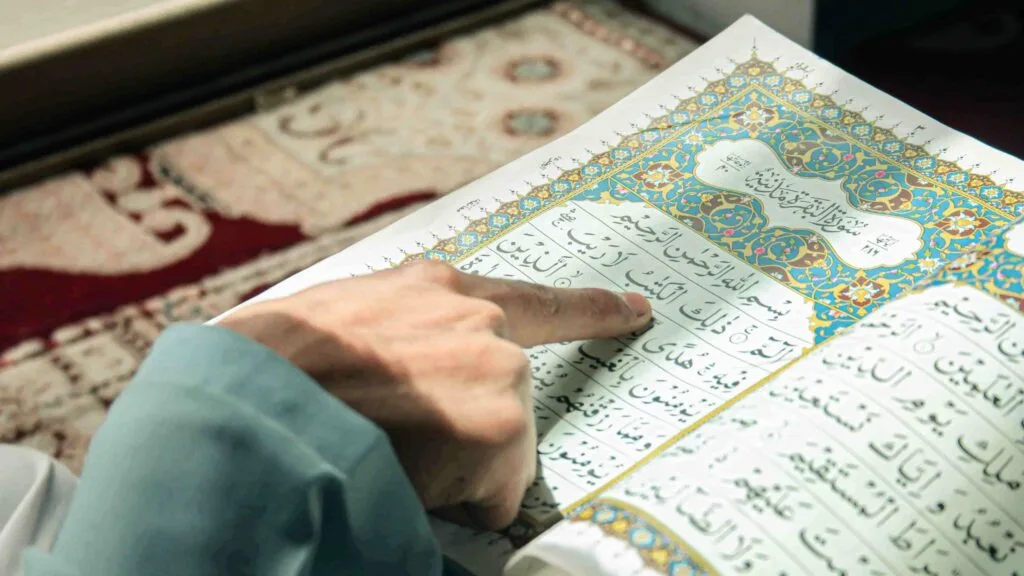
If you’re reading this, chances are classical Arabic is what you really want. It’s the Arabic the Quran came in. Allah says so Himself in Surah Yusuf, verse 2: He sent it down as an Arabic Quran so that you may understand. Understand. That’s the point of the verse, not just reading the words nicely.
Scholars took this seriously. Ibn Taymiyyah emphasized in Iqtida al-Sirat al-Mustaqim that knowing Arabic is important for understanding the religion.
His reasoning was simple: understanding the Quran and the Sunnah is required, and you can’t fully do that without the language. You may not agree with every detail of how people apply that, but it’s hard to read and not feel a bit of pressure to start.
Is it hard? Yes, a little. Mostly the vocabulary, because some words carry older meanings you won’t meet anywhere else. The sentences can feel packed too. But here’s what helps: the same words come back again and again in the Quran. Start with common Quranic Arabic words, and you’ll recognize more than you expect. Wondering if you can just learn from the Quran itself? Can you learn Arabic from the Quran tackles that. And learning Arabic to understand the Quran lays out the bigger picture.
Modern Standard Arabic and Why Courses Start There
MSA is what you’d hear on a news bulletin. It grew out of classical Arabic in the 1800s and picked up words and modern vocabulary for contemporary life, like “computer” or “parliament.” MSA simplifies some classical grammar, but the skeleton underneath is the same one.
And that skeleton is why Quran students bother with it. Case endings, verb patterns, how a sentence hangs together: you learn them here, and they carry over. Will MSA alone get you through every verse? No. The overlap is smaller than most beginners think. But it takes away that locked-door feeling, which matters more than it sounds. It’s also handy for reading and work, so you get two uses out of one effort.
Grammar scares people; I get it. You don’t need all of it at once, though. Learning Arabic grammar quickly and easily shows what to focus on first. Don’t skip listening either. The importance of listening in learning Arabic explains why your ears need as much training as your eyes. And if you want to move quicker, there are tips to learn Arabic at a fast pace.

Why the Types of Arabic Sound So Different When Spoken
Dialects are where the types of Arabic drift furthest apart. Egyptian, Levantine, Gulf, Maghrebi, and more. Each has its own words, its own music. A Moroccan and a Kuwaiti chatting casually can lose each other quickly, yet both could read the same page of the Quran with no trouble at all.
Not a modern problem
Ibn Khaldun noticed this in the Muqaddimah back in the 14th century. He saw that the spoken Arabic of his time had moved away from the language of the early Arabs, and he treated it as related but its own thing. The Quran had a hand in this: it kept the written language steady while everyday speech kept changing.
So which dialect?
Whichever one you’ll hear. Egyptian Arabic is widely understood across much of the Arab world, partly due to Egyptian film and TV
Just try to say hello in Arabic, and you’ll see how quickly dialects diverge. Thank you in Arabic does the same. And Arabic directions and transportation vocabulary is the sort of thing you’d pick up first in a dialect class.
If chatting in Egyptian Arabic is what you’re after, have a look at Alif Arabic’s Egyptian Arabic course.

How to Choose Between the Types of Arabic
Forget the labels for a second and ask yourself why you’re here. Want to follow the Quran in salah? You’ll need classical Arabic, and MSA first will shorten the road. Mainly want to read Islamic books or understand a khutbah? You’re somewhere in between. Got Arabic-speaking in-laws? Then a dialect comes first, since that’s what they speak at dinner.
Plenty of people end up wanting two. Fine. The order matters more than how many you pick. Dialect first and Quran later is a different road from MSA first and dialect later, and neither one is wrong.
What really makes a difference is having someone steer you. A good teacher knows which type you’re aiming for and skips the detours. How to choose an Arabic tutor tells you what to ask. Choosing the best online Arabic course helps you compare programs. And if the Quran is your main goal, the online Quranic Arabic course guide is worth a read.
What Nobody Can Tell You Up Front
People love asking which type of Arabic is best. I’d drop the question. They’re not ranked. A prayer mat isn’t better than a kitchen table; they just have different jobs in the same house.
What’s trickier is that some of you will cross more than one gap, and nobody can promise how long each takes. Someone who’s recited the Quran for twenty years might find classical Arabic closer than they feared. Someone with great spoken Arabic might find it farther away. You only find out by starting with the type that matches your reason, then seeing what comes next.
And if the Quran is why you’re here, Alif Arabic’s Qur’anic Arabic course is built around that goal, so enroll when you feel ready.
Frequently Asked Questions
How many types of Arabic are there?
Three main ones: Classical, Modern Standard, and dialects. Dialects are really dozens of regional varieties, so “three” is a handy simplification.
Is the Arabic of the Quran the same as Modern Standard Arabic?
Close, but no. MSA comes from classical Arabic and shares its grammatical backbone, but it has newer words and a simpler style. With a solid MSA base, you can follow a good part of the Quran, though many verses still need classical vocabulary and a teacher.
Should I learn a dialect or MSA first?
Depends on your goal. Quran and Islamic study, go with MSA first. Family or travel, start with a dialect.
Why can’t I understand native speakers after studying MSA?
Happens to almost everyone. MSA is the formal written standard, and nobody chats in it at dinner, so what you learned just isn’t what’s being spoken around you. Your effort wasn’t wasted. Listening to one specific dialect closes most of the gap, but not in a week.
Can I understand the Quran without learning a dialect?
Yes. Quran study runs on classical Arabic, and dialects aren’t needed for it. A dialect can still help if you want to chat with a teacher or follow lectures given in spoken Arabic. Whether that’s worth your time is up to what you plan to do with your Arabic.


