
Within the first few weeks, a lot of beginners learning Arabic hit the same wall. Not the alphabet — that part is often the easier part for many learners. Once you push past the first few days of the letters looking like unfamiliar shapes. It’s the Arabic grammar.
Someone hands you a table of endings, throws around words like nominative and idafa, and suddenly you’re not learning a new language so much as trying to learn a second, separate subject called “how this language explains itself.”
The standard fix is to memorize the table. Endings, charts, drills — and to be fair, that approach isn’t wrong exactly; it’s just slow, and it tends to produce students who can recite a rule without being able to use it in a sentence they just made up.
Arabic grammar isn’t really a list sitting next to the vocabulary. It’s more like the wiring underneath it — the thing that tells you who’s doing what to whom, especially in a language where word order doesn’t carry that information the way it does in English.
This isn’t a full course in Arabic grammar, and it doesn’t try to be. It’s five ideas — the ones that, once they click, make almost everything after them faster to pick up.
Some readers here are working toward Quranic Arabic specifically. Others just want to read a menu in Cairo, follow the news in Modern Standard Arabic, or stop feeling lost every time a grammar term gets thrown at them in class. All five ideas apply either way, in most cases.
Why Arabic Grammar Doesn’t Play by Word-Order Rules
If you’ve studied another language, or just grew up speaking English, there’s a habit sitting quietly in the back of your mind: the order of words tells you who did what. Subject, verb, object — rearrange it and the sentence usually breaks, or at least starts to sound wrong.
Arabic doesn’t lean on that the same way. It’s like, you can flip the subject and verb around in a sentence, and the core meaning survives, because Arabic marks a word’s grammatical role directly on the word itself — through an ending, not through where it sits in the sentence.
That’s worth sitting with for a second, actually, because a huge amount of the “why is this rule even here” frustration later traces back to expecting English logic in a system that was never built on it.
Once that shift lands, Arabic grammar stops looking like an arbitrary pile of exceptions and starts looking like something with a spine to it — a system, not a list.
Nominal Sentences Come First for a Reason
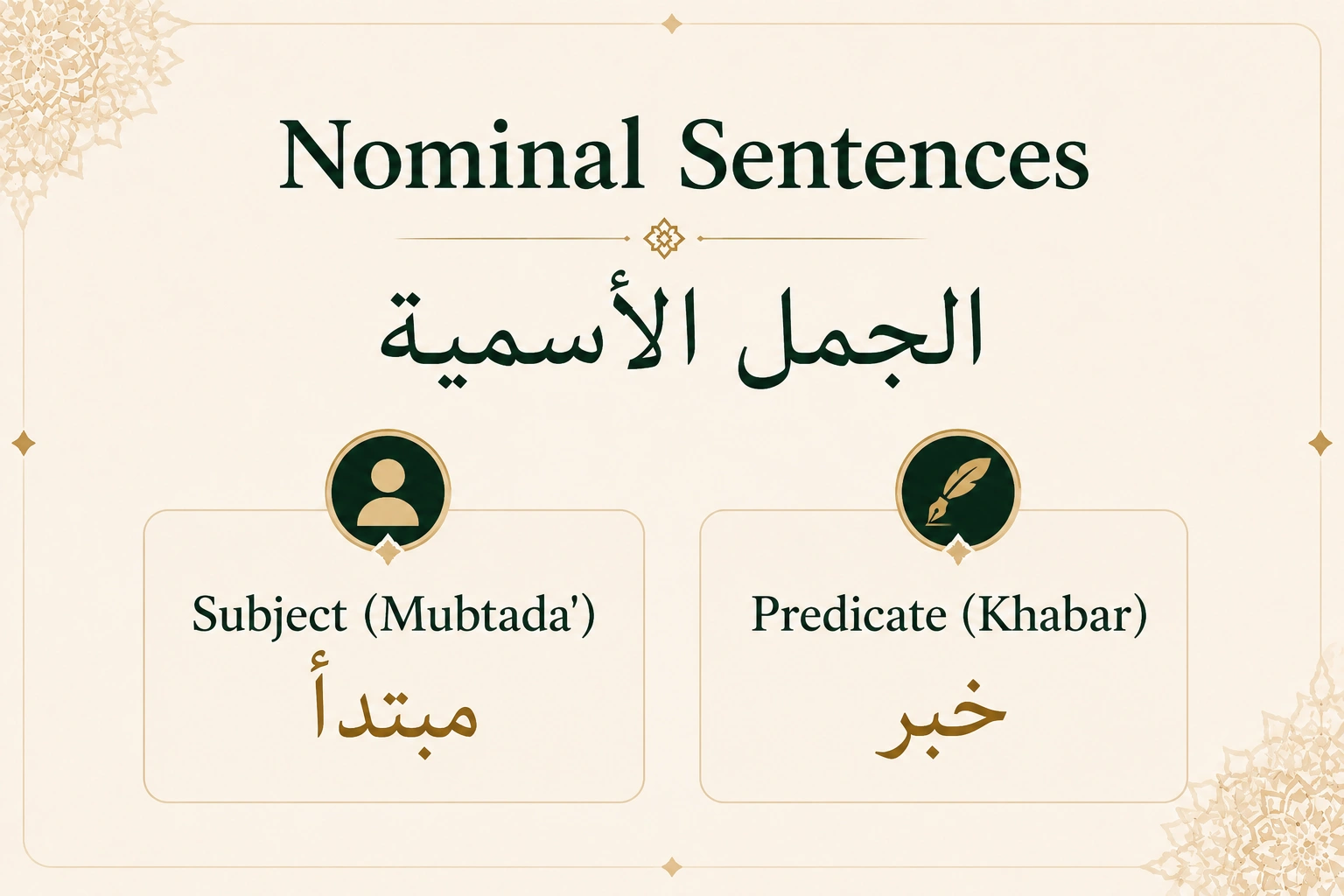
Arabic splits sentences into two basic types: ones that open with a noun (jumlah ismiyyah) and ones that open with a verb (jumlah fi’liyyah).
زَيْدٌ طَالِبٌ — “Zayd is a student” — has no verb at all. The relationship between the two nouns is the sentence. Most teaching programs start here on purpose, because it lets a beginner build a real, grammatically correct sentence before conjugation ever enters the picture.
If you want a structured way through exactly this kind of foundation — Alif Arabic’s Arabic for Adults course starts here and builds outward. Worth a look.
Case Endings in Arabic Grammar: the Part Everyone Warns You About
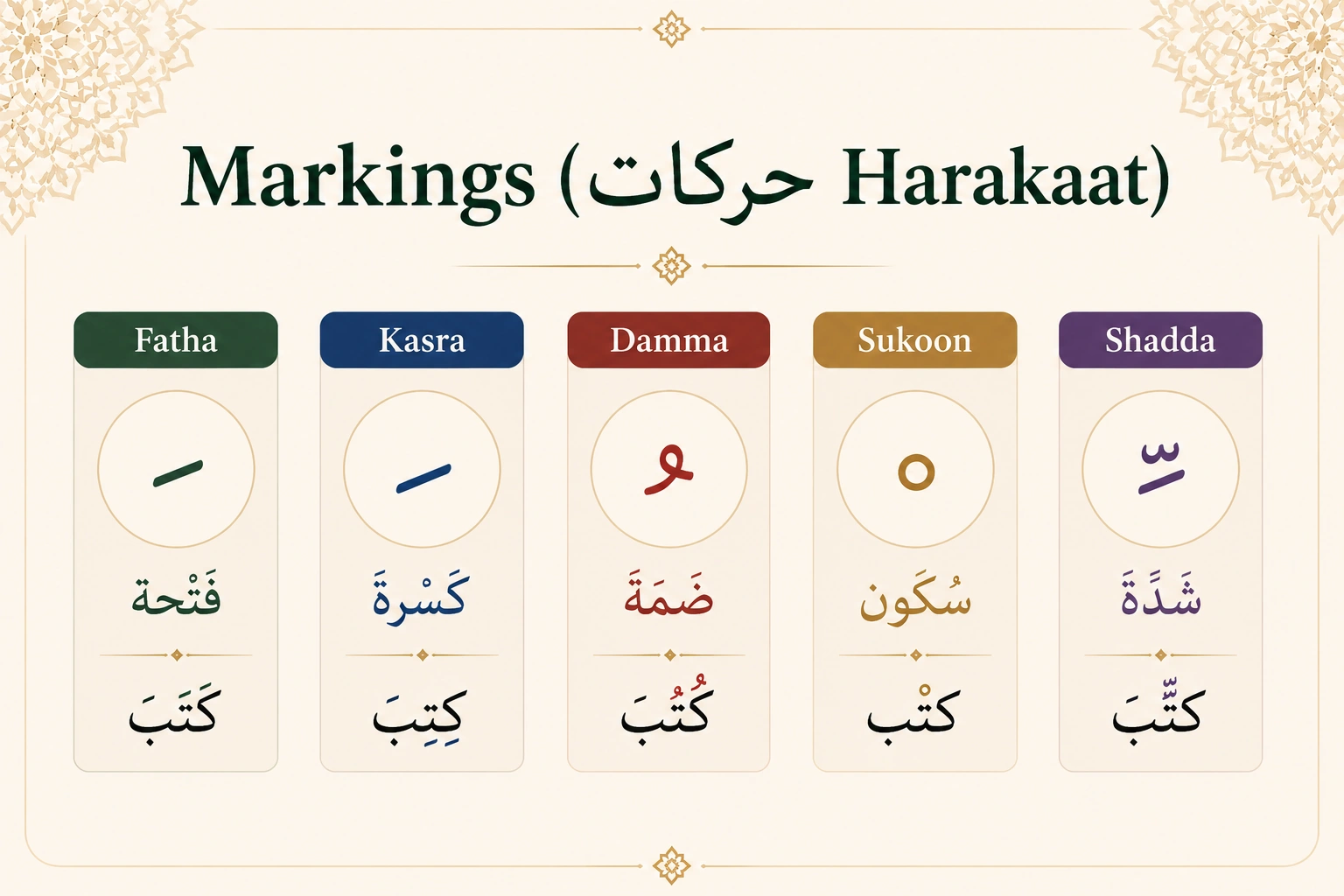
This is the one with a reputation, and honestly, some of that reputation is earned. إعراب Iʿrāb — the system that marks a noun as nominative, accusative, or genitive — asks the ending of a word to do a job that English just doesn’t ask endings to do at all.
كِتَابٌ, كِتَابًا, كِتَابٍ. Same word, three different endings, three different jobs in the sentence.
- Subject gets the nominative.
- Object of a verb gets the accusative.
- A noun after a preposition, or the second noun in a possessive phrase, gets the genitive.
Hear the difference between those three vowel sounds and you’re not decorating your Arabic for style points — you’re tracking, in real time, who’s doing what to whom in a sentence where word order alone won’t tell you.
Not everyone needs full fluency in this on day one, and plenty of spoken Arabic relaxes these endings anyway. But being able to spot them on the page — especially in a vowelled text — changes what you’re actually able to read, not just what you can say out loud.
Roots in Arabic Grammar: Why One Root Can Open Many Words.
Many Arabic words trace back to a three-letter root carrying a core meaning, and once you’re holding that root, whole families of vocabulary stop feeling like separate flashcards.
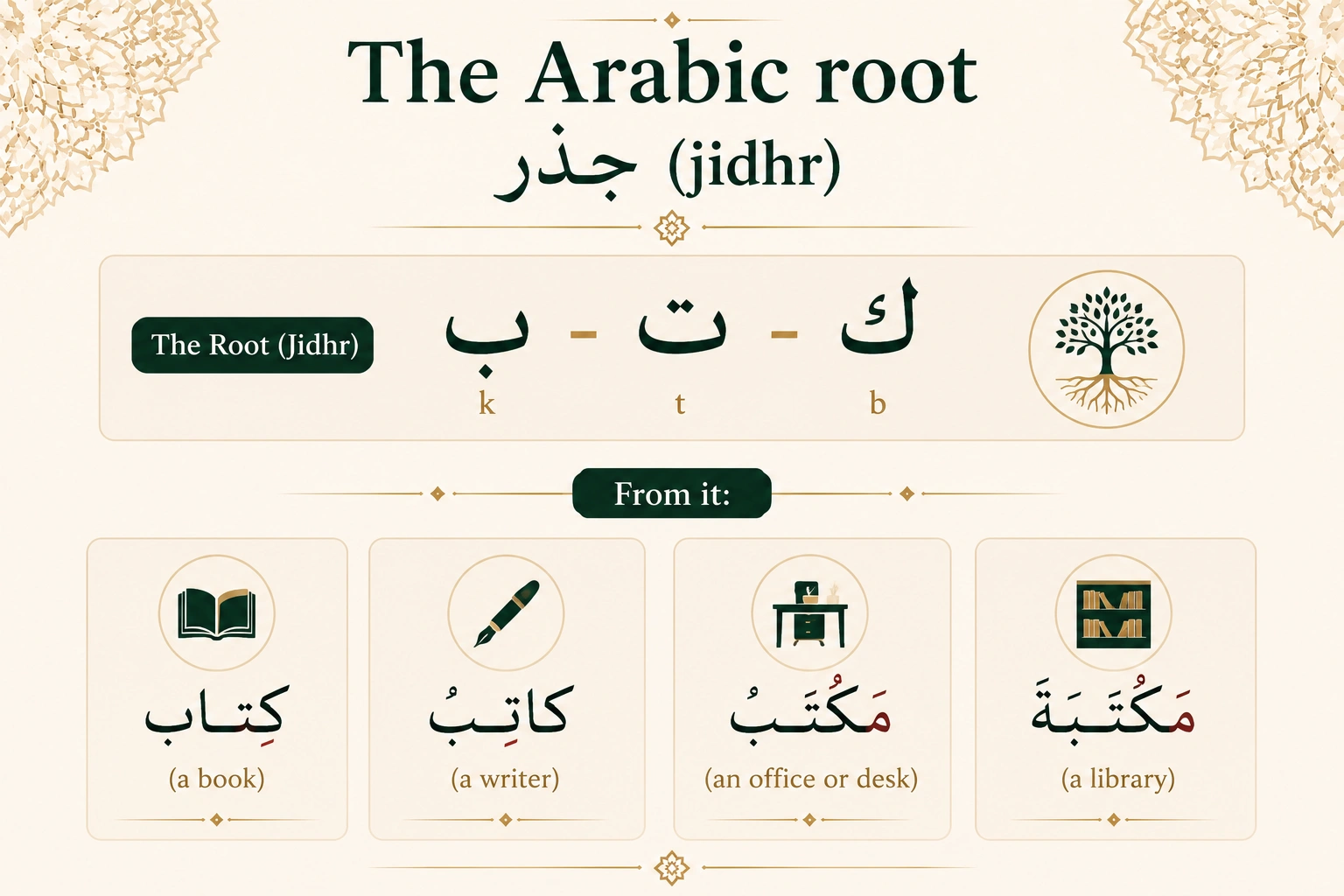
Take ك-ت-ب, tied to the idea of writing. From it:
- كِتَاب (a book)
- كَاتِب (a writer)
- مَكْتَب (an office or desk)
- مَكْتَبَة (a library).
Four words. One root. One idea running underneath all of them, showing up in slightly different clothes each time.
This is a grammar concept as much as a vocabulary one, because the patterns that turn a root into a noun, a verb, an adjective, or a “place where the action happens” word are themselves grammatical machinery.
Learn the pattern once, and you start predicting words you’ve never seen rather than memorizing each one from scratch. Not a shortcut, not exactly — more like learning the engine underneath the vocabulary, so grammar and vocabulary start pulling in the same direction instead of feeling like two separate mountains to climb.
For learners whose main goal is Quranic vocabulary specifically, root recognition tends to be the single fastest thing to invest in early — which is a lot of what Alif Arabic’s Quranic Arabic course is built around, for anyone whose Arabic is headed in that direction.
Verb Conjugation in Arabic Grammar, Without Losing the Thread
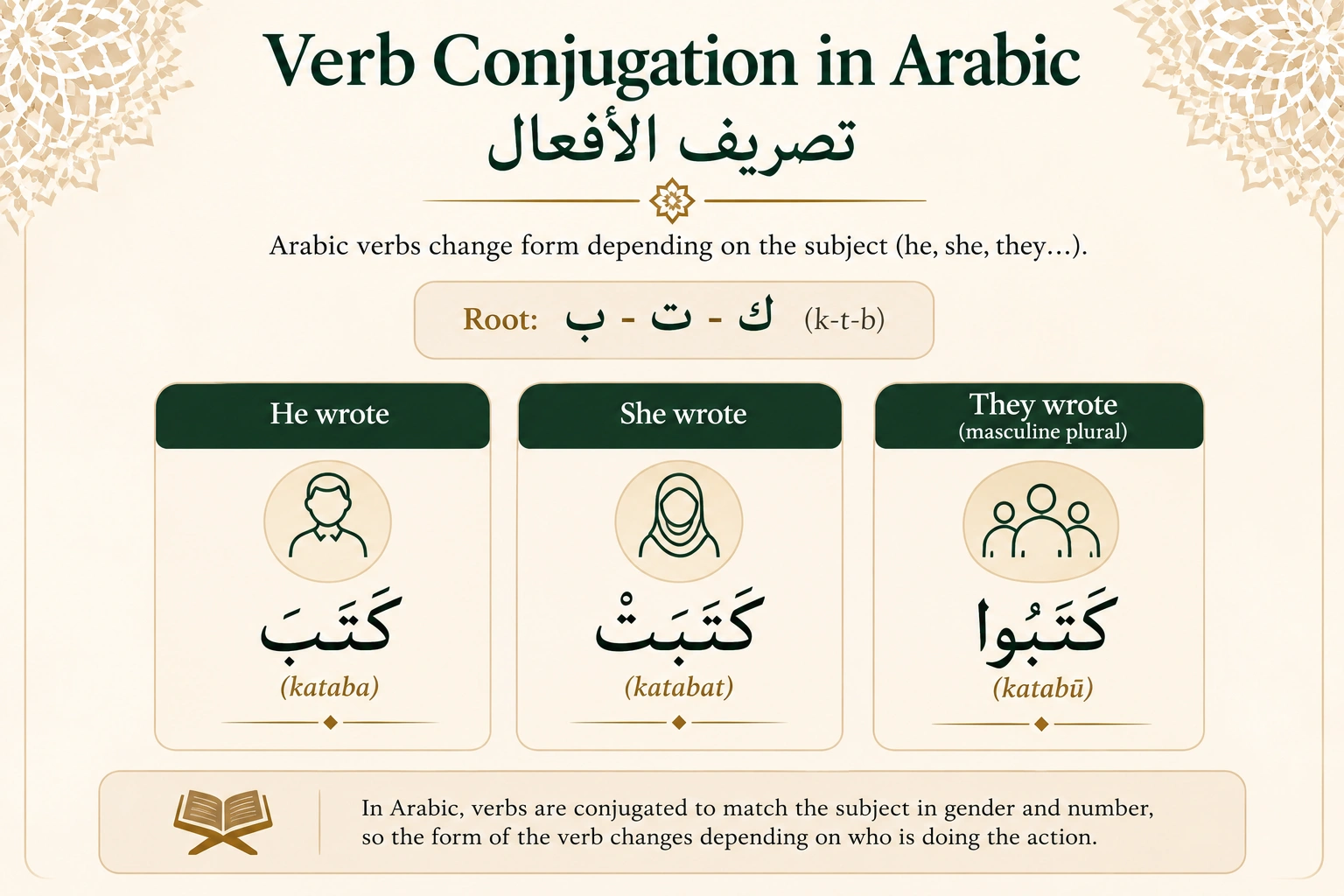
Arabic verbs conjugate for tense — fine, expected — but also for the gender and number of whoever’s doing the action, and this is usually where people feel the grammar load spike all at once.
- كَتَبَ (“he wrote”)
- كَتَبَتْ (“she wrote”)
- كَتَبُوا (“they wrote,” masculine plural).
The root stays recognizable in each one. What shifts is everything around it, carrying information that English usually just hands off to a separate pronoun.
The instinct is to treat every conjugated form as its own vocabulary word to memorize, which is slower than it needs to be. Because the root holds steady and the pattern around it is genuinely predictable, learning that pattern once — for a handful of common verb shapes — gives you access to conjugating verbs you’ve never even encountered before.
This is arguably where all the earlier grammar work actually pays off, because it’s the difference between recognizing a verb on a page and being able to use one yourself.
Verb Forms Aren’t Random Either
Arabic organizes verbs into a set of recurring patterns — often called “forms” — that shift a root’s core meaning in predictable directions: causative, reflexive, reciprocal. Learn a handful of these patterns and a huge number of verbs stop being new information and start being a familiar shape wearing a different root.
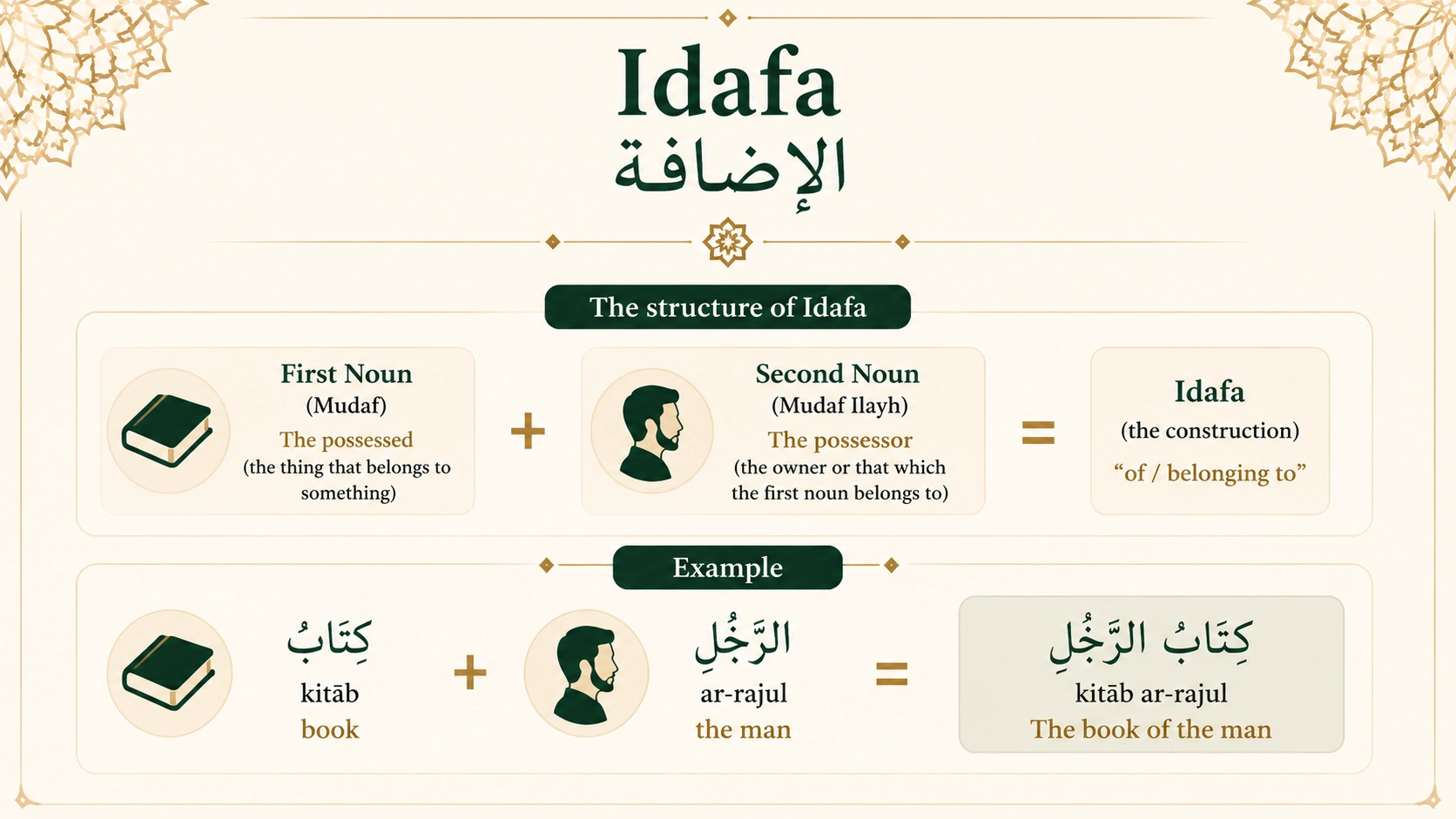
Idafa الإضافة: the Possessive Structure You’ll See Constantly
The last piece is smaller in scope but shows up everywhere: idafa, Arabic’s way of expressing possession by linking two nouns directly, with no separate word standing in for “of.”
بَيْتُ الرَّجُلِ — “the house of the man” — puts the possessed noun first, the possessor second, and the second noun takes the genitive ending as a rule rather than an exception. It also covers many close relationships, not just ownership.
You’ll run into this constantly, in everyday speech, in news Arabic, in classical writing. Ibn Khaldun, writing in the Muqaddimah on Arabic language and how it should be taught, treated grammar less as decoration and more as the actual tool that lets a student reach meaning directly instead of through translation — and idafa is a clean example of exactly the kind of thing he meant. Miss the structure and a phrase reads as two loose nouns bumping into each other rather than the single, deliberate relationship it actually is.
Readers aiming at written, formal Arabic — where idafa constructions turn up constantly, in news writing especially — may find Alif Arabic’s Modern Standard Arabic course closes that particular gap.
So What Actually Changes Once These Five Arabic Grammar Rules Are in Place
None of this makes Arabic grammar simple. What it does is give the difficulty a shape — five moving pieces instead of one undifferentiated wall of rules, which is a lot closer to how the language actually organizes itself than most beginner materials let on.
Interestingly, this idea — that structure has to come before real access to meaning — isn’t a new one. Ibn al-Jazari, writing centuries ago on the science of Quranic recitation, argued that the mechanics of a language have to be understood before its deeper meaning can land properly; you can’t skip the scaffolding and expect the building to hold. That applies whether someone’s reading a novel, a newspaper, or a religious text. Grammar is the scaffolding. It’s not the point of learning Arabic. It’s just what makes the actual point — reading it, following it, using it — possible in the first place.
If you’ve got the alphabet down and vocabulary is starting to build, but sentences still feel like guesswork, the Reading Arabic program at Alif Arabic was built for exactly that stage. Explore more courses here.
Frequently Asked Questions
How long until these five Arabic grammar ideas stop feeling foreign?
Many learners get a working handle on them somewhere around the two or three month mark, if they’re studying consistently. But “I get it” and “I don’t have to think about it anymore” aren’t the same milestone — the second one, especially with case endings, takes a while longer and mostly comes from just reading a lot, not from going back over the rule again.
I still mix up case endings in Arabic Gammar all the time. Is that normal, or am I doing something wrong?
Normal. Genuinely one of the most common places people get stuck, and it’s not really a you problem. Case endings mostly disappear in casual spoken Arabic, so if your practice has been mostly speaking and listening, of course they haven’t sunk in yet — you just haven’t spent time where they actually show up.
Should I be doing Arabic grammar and vocabulary at the same time, or one before the other?
Same time, pretty much always. Grammar with no vocabulary is a frame with nothing hung on it. Vocabulary with no grammar is a pile of words you can gesture at but not actually connect. And root-based learning helps with both at once — one root, and suddenly you’ve got three or four words instead of one.
Do I have to memorize words like marfoo’ and mansoob right out of the gate?
Not right away, no. It does help to at least recognize them early on, though, since basically nothing — no textbook, no app, no teacher — bothers translating the terms for you. What matters more at first is getting the actual idea (what job is this word doing in the sentence) rather than being able to spit the label back on demand.


