
Many learners don’t set out to learn Egyptian Arabic on day one. Usually there’s something else first. A trip that’s coming up, a show somebody got hooked on at 2 am, a friend they’re tired of just nodding along with. Then somewhere in that process, someone tells them Egyptian is the dialect to learn. They go looking for a reason, expecting it to be a sales pitch.
It mostly isn’t, though, which is honestly a little annoying if you were hoping to poke a hole in it. There’s a real explanation for why so many learners end up here instead of somewhere else. And it has almost nothing to do with the grammar being easier. It has more to do with the fact that Egyptian media played a major role in making sure the dialect is widely understood across the Arab world, without really trying to.
So here’s the actual case for Egyptian Arabic. Not the polished version — what’s really going on with it, why it’s usually the default, and where it runs out of road if that’s not quite the whole answer you needed.
Why People Outside Egypt Already Half-Understand Egyptian Arabic
This is the part that tends to surprise people. Egyptian Arabic has something close to a hundred million native speakers, with tens of millions more who understand it beyond that — which by itself isn’t strange. Several dialects have big numbers behind them. What’s strange is the second half of that sentence.
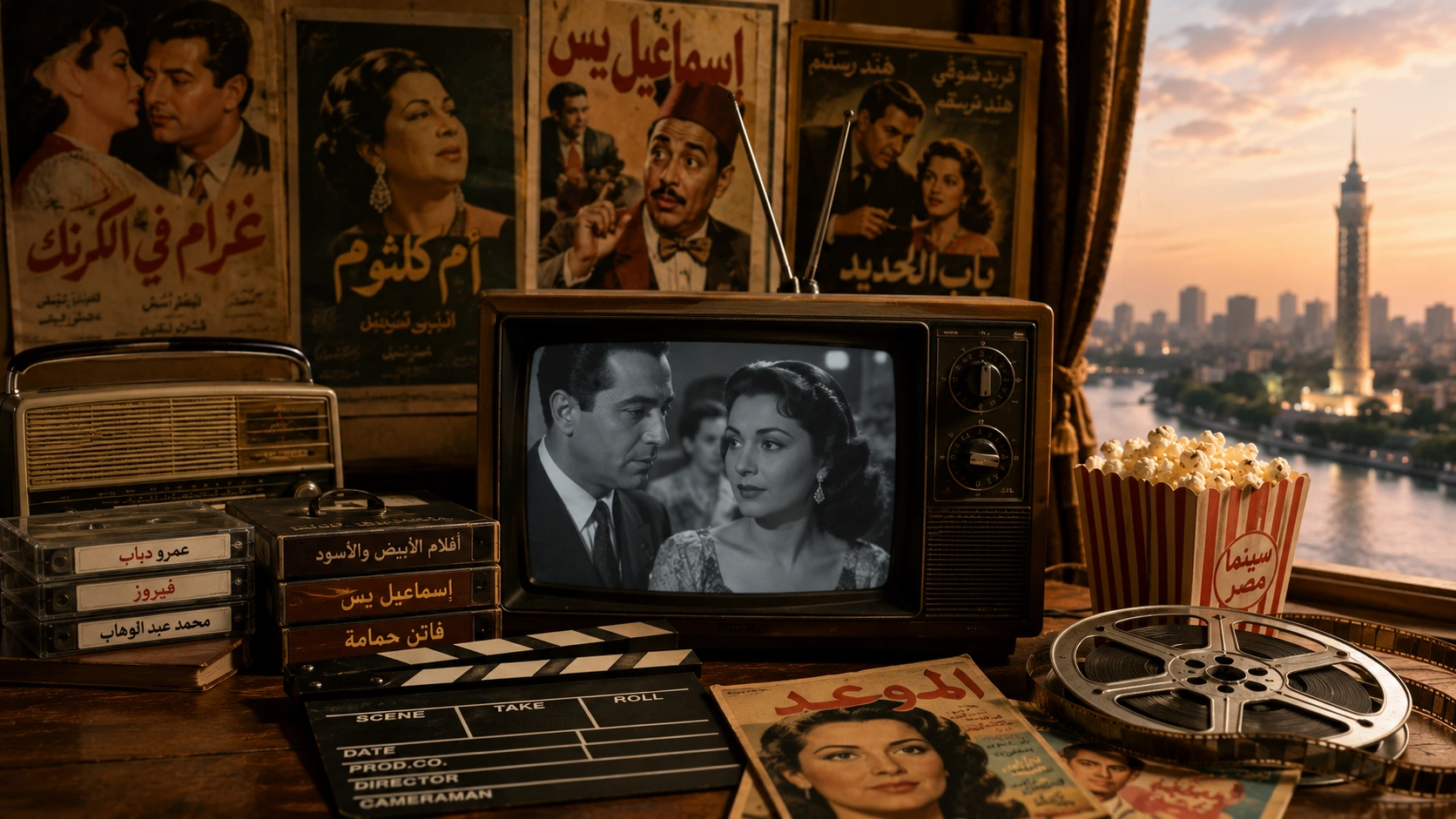
Ask a Moroccan, a Saudi, and a Yemeni which dialect they understand best, and Egyptian usually comes out ahead — sometimes ahead of each other’s own regional neighbors, even. That’s not really about the language being simpler to parse. It’s history, mostly. Egyptian film and television ran the table on Arab pop culture starting in the 1930s, and it didn’t let up for decades. Many movies people’s grandparents grew up watching were Egyptian. The music people’s parents wore out on cassette was Egyptian too, sung in the Egyptian dialect, no subtitles needed because everyone already knew the words. An entire region picked the dialect up sideways — through television, through songs, through half-remembered film lines — long before most of them ever met someone from Cairo in person.
Which leaves a learner in an odd position, honestly. Pick up Egyptian Arabic, and you’re not just learning to talk to Egyptians specifically. You’re picking up something closer to a shared regional dialect, minus the stiffness of using textbook Arabic at a market stall or over dinner with someone’s family. That’s a strange kind of pull for one country’s way of speaking to have on an entire region, and it’s worth sitting with before deciding it doesn’t apply to your own reasons for learning.
If reach across the region matters more to you than any one country’s dialect specifically — Alif Arabic’s Egyptian Arabic course is built around exactly that kind of everyday, spoken fluency.
What Changes Once You Leave the Textbook Version Behind
Modern Standard Arabic — MSA, most people just call it that — is what shows up in news broadcasts and government paperwork and nearly every beginner course on the market. It is not what anyone in Cairo says over breakfast, and it never has been.
The gap starts small. It doesn’t stay that way. Say “a beautiful book” in formal Arabic, and you get an extra vowel tacked onto the ending of each word — case markers, technically. Say it in Egyptian, and those endings just aren’t there anymore. Verbs loosen up in a similar way.
Egyptian speech often drops the verb “to be” entirely in the present tense — “I am happy” comes out closer to “I happy,” which sounds like laziness until you realize it’s a different grammar doing the same job with fewer parts, not a shortcut through a harder one. Negation works differently too — Egyptian wraps the negative around the verb in two pieces instead of using one negation word the way MSA does — and the dual form, MSA’s special grammatical category reserved for exactly two of something, mostly just disappears. Egyptian uses the regular plural instead. Why keep a whole extra category around for the number two? Egyptian speakers apparently asked the same question a long time ago and stopped bothering.
Where does that leave Egyptian Arabic?
None of that makes it a broken or lazy version of “real” Arabic — a framing that gets repeated more than it should, usually by people who haven’t actually sat with either register long enough to notice. It’s a complete grammatical system built by daily use rather than formal writing, and if that sounds unusual, it isn’t really. Written and spoken English also differ in structure and usage. Nobody talks the way contracts are written, and nobody calls spoken English broken because of it.
There’s also the vocabulary, which carries its own strange little history. Egyptian Arabic has picked up words from several languages, including Coptic, Greek, Turkish, French, and English over the centuries — leftovers from everyone who passed through or settled there. Some of it’s obvious the moment someone points it out. Some of it just sounds Arabic until you learn otherwise, and by then it’s stuck — you’ve already absorbed it as if it always belonged.
Why So Many Beginners Land in Egyptian Arabic First
“Easier” gets thrown around too casually in most Arabic-learning content, and honestly this article probably isn’t immune either. But something real does sit underneath the word here.
Some of it is structural. Some learners find the early verb patterns more approachable. No dual forms cluttering things up. A present tense that behaves more predictably than MSA’s does. Many adult learners really do find Egyptian more approachable early on compared to some other dialects, and the simplified grammar is a genuine part of that — not just something people tell themselves after the fact to feel better about the choice.
But the bigger piece, probably, is exposure. There’s simply more Egyptian material floating around to learn from than for almost any other dialect. more films, more music, more everyday conversation online. And immersion only works if there’s actually enough content to immerse yourself in. Someone who’s had an Egyptian playlist running in the background for years already has an ear for the sounds before they’ve opened a single grammar page. That’s not a small advantage. Grammar layered onto sounds you half-recognize sticks in a different way than grammar you’re meeting cold, for the first time, with no context to hang it on.
If your immediate goal is being able to actually hold a conversation, not just recognize words on a page — Alif Arabic’s Arabic for Adults course is built around exactly that kind of practical starting point.
A Rough Order People Fall Into, Even Without Meaning To
There’s a pattern that keeps showing up among adult learners — nobody sat down and planned it this way, and yet here it is, over and over. For Many learners, dialect first, for the comfort of actually understanding and being understood. Formal Arabic later, once reading and writing start to matter more.
That’s not the only order that works. Plenty of people go straight into MSA and never touch a dialect at all, especially if their goal is purely written Arabic, or media, or academic material where the spoken side barely comes up. But someone starting from actual zero — no exposure, no background, nothing to build off yet — tends to find that dialect first lowers the entry cost just enough. Arabic stops being an abstract rule system on a page and starts being something usable, this week, with an actual person on the other end of it, not eventually.
MSA still holds the position of shared formal standard everywhere — academic writing, official communication, the news — and there’s no route to real fluency that skips it forever if your goals stretch that far. It just doesn’t have to be the door you walk through first.
Where Egyptian Arabic Runs Out
Worth saying plainly, since a lot of pages on this topic conveniently skip it. Egyptian Arabic alone won’t usually be enough for formal news articles or professional writing. It won’t help you write a professional email or follow academic Arabic — none of that is really its job.
MSA remains understood everywhere across the Arab world in a way that any dialect, for all its reach, still isn’t once you’re talking formal or written contexts. If reading, writing, or professional Arabic is actually the goal, dialect alone doesn’t get you there, no matter how far its spoken reach stretches.
What it does solve is smaller and more immediate. That is the problem of Arabic staying permanently theoretical. Why? Because you never built any real comfort with how it actually sounds coming out of a person’s mouth. Whether that’s the problem you’re trying to solve, or whether the formal register is what you actually need more urgently, is a question worth sitting with honestly before deciding where to start.
If formal, written Arabic is ultimately where you’re headed — for work, study, or anything official — Alif Arabic’s Modern Standard Arabic course builds that foundation directly.
Frequently Asked Questions
Is Egyptian Arabic really the most understood dialect across the Arab world?
Yes. It’s not the largest by native-speaker count alone. Gulf Arabic and Levantine Arabic both have serious claims there. But, decades of Egyptian film and music gave it a level of cross-regional recognition the others don’t quite match.
Is Egyptian Arabic actually easier than Modern Standard Arabic?
For speaking and listening, many learners do find it more forgiving — fewer conjugation rules, no dual forms, simpler verb patterns. Reading and formal writing tell a different story, though. MSA still does the heavier lifting there, and no dialect really replaces that.
Should I start with Egyptian Arabic or go straight to Modern Standard Arabic?
Depends what you need soonest, honestly. Real conversation, and dialect first tends to build confidence faster. Formal reading or writing, and MSA earns the priority instead. There isn’t one right answer here.
Can I get by with just Egyptian Arabic and never touch MSA?
For everyday spoken conversation across much of the region, yes. But the moment your goals touch formal writing, news, or academic material, you’ll need MSA eventually. That part doesn’t really have a workaround.
Will people outside Egypt actually understand me if I learn the Egyptian dialect?
In most cases, yes, and often better than people expect going in. It’s one of the few dialects with that kind of cross-regional pull, mostly thanks to decades of Egyptian media reaching places Egyptians themselves never physically traveled to.


