
Somewhere around week six, something shifts. Not for everyone at exactly that point — but close enough. You can sound out the letters by now. A handful of words jump out at you on sight, which feels like real progress. Then you sit down with the Quran, actually try to read it start to finish. And the ninety-day timeline you were promised starts looking a little thin. The words on the page don’t quite match what was on last week’s vocabulary list.
That’s not a sign you did something wrong. It’s more that the advice you followed was probably built for a different goal than yours. A lot of “learn Arabic fast” content is aimed at travelers — people who need to order food and get through customs in under a month, which is a fine goal, just not the one you have. If you’re learning Arabic to actually understand the Quran, to have a verse you’ve recited a hundred times finally land, “fast” starts to mean something else.
So this isn’t a promise of fluency by next month — nobody can honestly give you that. What it can do is walk through what learning Arabic fast actually looks like. Sepcifically for someone whose target is Quranic Arabic, where the real shortcuts are, and, honestly, where a shortcut costs more than it saves.
What “Fast” Actually Means When You’re Learning Arabic for the Quran
Ask around about how to learn Arabic fast, and you’ll hear some version of the same three tips almost every time. immerse yourself, learn common phrases first, practice daily. None of that is bad advice, exactly. It’s just not aimed at someone whose real target is Quranic vocabulary instead of café small talk.
Quranic Arabic and the spoken dialects you’d pick up through immersion overlap less than people assume going in. Someone who spends three fast months on conversational phrases can come out speaking reasonably well. But still find the Quran nearly as unfamiliar as before — the words are related, sometimes closely, sometimes barely. Speed aimed at the wrong target isn’t really speed. It’s just motion, and motion feels like progress until you stop and check where you actually landed.
Ibn Khaldun made a version of this point long before language pedagogy became its own field. In the Muqaddimah, he wrote about language ability — malaka. A kind of faculty or disposition — as something built through sustained exposure and repetition rather than through one intense push. A fast learner, in his framing, isn’t the person covering the most ground in the least time. It’s whoever builds the right habit early enough that everything after it starts compounding on its own.
If understanding the words you recite matters more to you than general conversation, Alif Arabic’s Quranic Arabic course is built around that target specifically — enroll and start from there.
Where Fast-Track Methods Tend to Break Down for Quranic Arabic
Immersion is usually the first suggestion for anyone asking how to learn Arabic language quickly. Move somewhere Arabic-speaking, surround yourself with it, let your brain adjust. It works, genuinely, for spoken fluency. It does considerably less for the grammatical patterns that show up constantly in Quranic Arabic and rarely in everyday speech. The case endings, certain verb forms tied to older patterns, vocabulary that hasn’t been in casual use for centuries.
There’s a second issue with speed-focused methods, and it’s a little harder to spot. Many of them push speaking as early as possible, which means grammar gets set aside for “later” — and later, for a fair number of learners, just never quite arrives. You end up with maybe two hundred working words and not much of a framework for the next two thousand. That trade can work fine if you’re headed somewhere on a trip. It works less well if the actual goal is reading the Quran with real comprehension.
What tends to speed things up for Quranic Arabic learners looks almost backward compared to the usual advice. Less time on isolated memorized phrases, more time on the handful of grammatical patterns that keep showing up across the Quranic text. Verb forms. Case markers. The way one added letter can shift meaning entirely. Learn those reasonably early, and vocabulary starts sticking with less effort, because you can finally see why a word means what it means instead of just having memorized that it does.
Learning Arabic Quickly Without Skipping the Foundation
Here’s the part that’s a bit uncomfortable to say to someone chasing speed. The quickest path still runs through the alphabet, through basic sentence structure, through reading before speaking gets much attention.
Skipping ahead doesn’t actually save time. It just moves the cost further down the road, to a point where you’re unlearning habits instead of building them properly the first time . Which tends to take longer than doing it right from the start would have.
Reading Comes Before Speed
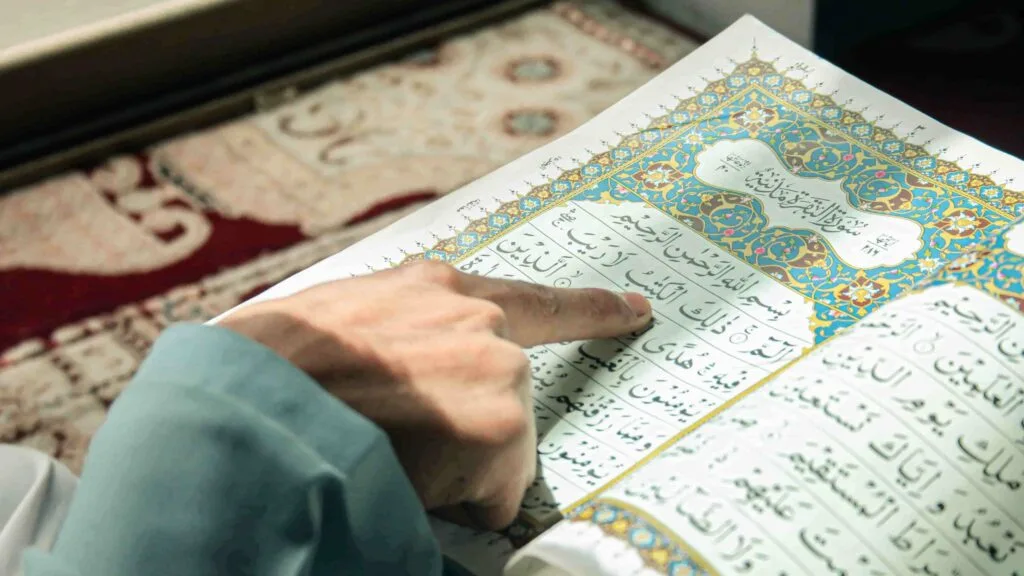
Picture yourself speaking within weeks — that’s usually what people imagine when they ask how they can learn Arabic fast. But for someone learning Quranic Arabic specifically, reading fluency arguably matters more than conversational speed, and it comes first for a fairly practical reason: vocabulary is hard to build efficiently while you’re still sounding out letters one at a time.
Once reading feels automatic, everything downstream tends to move faster — vocabulary, grammar recognition, even listening, since your attention isn’t tied up decoding the script anymore.
Repetition Tends to Beat Volume
Someone reviewing fifty words a day for two weeks will often retain more than someone who cycles through five hundred words just once. That runs against instinct a little — more exposure feels like it should mean more progress. But a smaller, well-chosen set of Quranic vocabulary, reviewed with some spacing, tends to outperform broad, shallow coverage more often than not. I
bn al-Jazari, writing on the science of Quranic recitation, leaned on something close to this — disciplined, repeated practice over sheer exposure to volume. A principle that predates modern memory research by five hundred years and still mostly holds up against it.
Getting Arabic script fluent early on tends to be the biggest single lever for everything that comes after — Alif Arabic’s Arabic Reading Course is built to get you there without the wasted detours.
Free Resources vs. Structured Guidance — What Actually Speeds Things Up
Plenty of people typing “how to learn Arabic for free” into a search bar are assuming cost is the real obstacle, and free resources can genuinely get someone off the ground. YouTube channels, free vocabulary apps, the odd downloadable PDF — none of it is worthless. But free, scattered material tends to share one gap in common: nothing tells you what to skip.
That sounds minor. It usually isn’t. A structured course sequences things so that lesson twelve assumes you’ve actually retained lesson three, and it cuts material that doesn’t serve your specific goal.
Free resources, pulled from different corners of the internet, can’t really do that for you — nobody curated the mix around your particular target. You end up piecing together your own curriculum out of fragments, which is exactly the kind of task that quietly eats the time you were trying to save in the first place.
None of this makes free resources useless as a starting point — they’re often a reasonable place to begin. It just means the “free” goal and the “fast” goal pull against each other more than people expect going in, and somewhere around month two or three, the cost of assembling your own path can end up outweighing whatever the free version saved.
What a Realistic Fast Timeline Looks Like
Some focused learners reach basic Quranic reading comprehension in around three months with consistent daily practice. Real fluency — the kind where nuance and rhetorical structure start landing without conscious effort — takes noticeably longer. Reasonable estimates put solid Quranic Arabic competence somewhere around one to two years for a learner studying consistently, not just occasionally.
That’s a longer runway than most “learn Arabic fast” headlines promise, and it’s the more honest one. The learners who do hit ambitious timelines usually aren’t the ones who stumbled onto some secret shortcut. They’re the ones who stopped spending time on methods built for a different goal than theirs — which, in a roundabout way, is where a lot of the time savings actually comes from.
The Real Trade-Off Behind Learning Arabic Fast
There’s a version of “fast” that just means cramming, and a version that means not wasting time — and the two can produce almost opposite results. The first tends to leave you further behind, since everything skipped has to get relearned eventually, often at a worse moment and with worse habits already settled in.
The second means front-loading the parts that feel slow at first — the alphabet, the case endings, the underlying grammatical logic — precisely because those are what let the following months move quickly instead of grinding down.
Whether that trade-off is worth it depends on what you’re actually learning Arabic for in the first place. If the goal were general conversational fluency, some of the standard shortcuts would make more sense than they do here.
But if the goal is sitting with the Quran and having a verse land the way it’s meant to — not just recognized, but actually understood — the slower-looking path tends to be the faster one in practice. Worth being honest about that up front, before three months get spent finding it out the hard way.
For adult learners who’d rather have that foundation built with some structure behind it, instead of assembled from scattered free material, Alif Arabic’s Quran for Adults course is a reasonable place to start.
Frequently Asked Questions
How long does it realistically take to learn Arabic fast for reading the Quran?
Many focused learners reach basic Quranic reading comprehension in around three months with daily practice. Real fluency — picking up nuance without translating word by word in your head — usually takes closer to one or two years of consistent study, not the ninety-day timeline some programs advertise.
Is it normal to feel like progress has stalled after the first few weeks?
Pretty normal, actually, and it happens to a lot of learners. The early weeks feel fast because the alphabet and basic vocabulary come quickly. The plateau that follows is usually where grammar and case endings start mattering more. And it can feel like backsliding even when it isn’t.
Can I learn Arabic for free and still reach a solid Quranic Arabic level?
Free resources can get you started, especially with the alphabet and early reading. Where they tend to fall a bit short is sequencing. Figuring out what to study next and what to leave out — and that gap is often what turns scattered self-study into wasted months.
Should I focus on Modern Standard Arabic first, or go straight to Quranic Arabic?
For learners whose main goal is the Quran, starting with Quranic vocabulary and grammar can be more direct, though some MSA reading can still reinforce the alphabet and basic patterns.
What’s the single fastest thing I can do this week to speed things up?
Get reading fluency solid before anything else. Vocabulary and grammar both tend to move faster once you’re not still sounding out letters one by one — and that one shift alone can unlock more progress in a month than any vocabulary app or phrase list on its own.


